Booknotes: 101 Poems Against War
Booknotes: 101 Poems Against War, edited by Matthew Hollis and Paul Keegan

Soldiers who wish to be a hero
Are pratically zero
But those who wish to be civilians
Jesus, they run into the millions
–Graffiti outside a WWII Latrine
I started reading this collection when the US went to war with Iran. “101 Poems…” was published on the eve of the last US war, and I find myself marking the yeas of my life in the wars that my country has started and fought.
There are classics in here, like Jarrell’s “The Death of the Turret Ball Gunner” and Niemoller’s “First They Came for the Jews” and Yeats' “On Being Asked for a War Poem." There are songs, like “Johnny I hardly Knew Ye” and “The Recruiting Serjeant” (below). The editorial selection leans pretty heavily to the 20th century, and pretty heavily on European and American poetry, though there are some Arabic and Persian poets represented, and a couple from east Asia and Africa. Some of the poems in here I knew, others were new to me. All of these poems take the stance that war, as Howard Zinn said, is not like wine, with good and bad years. War is like cyanide; one drop and you’re dead..
Like all anthologies, there are poems that spoke to me and poems that didn’t. Here are some that did.
-
lines from “The Recruiting Serjeant” by Isaac Bickerstaffe.
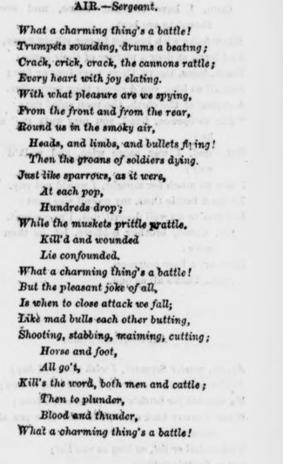
“What a Charming Thing’s a Battle!”
Repeated as refrain. First as the sublime, war as sensory pleasure. Second as tragedy, casualties mounting, but quantifiable, countable. Finally as horrific, visceral farce, limbs and blood and guts mixing and the eradication of all identity, all humanity supplicated to violence.
“What a Charming Thing’s a Battle!” -
Dulce Et Decorum Est by Wilfred Owen
Years ago, my wife had shared with me the anti-war poetry of Wilfred Owen, written while he was enlisted, and serving in the French front of the war to end all wars. I had forgotten that gift, until she reminded me when I mentioned I was reading this book. Dulce Et Decorum Est makes a mockery of the idea of war as anything glorified, with its wild-eyed images of men dying horribly in gassed trenches. Owen himself died a few days before the armistice that ended WWI. -
The Conscientious Objector by Edna St. Vincent Millay
This is one of the poems I had known before reading this book, but I was glad to read it again, like having an inspiring and hopeful conversation with an old teacher or mentor. I first read it last year when ICE started knocking on my neighbors doors. A reminder that, even in moments of extreme terror, the choices that we make to ourselves and each other, matter. Perhaps they matter more then, than any other time. -
The Horses by Edwin Muir
I have a thing for poems about strange horses. This is a poem about the world after war, what giving up war might allow us to be and to become. Full of apocalptic and prophetic and anti-modernist language. Strange horses, indeed. -
American Football by Harold Pinter
America is, perhaps unchallenged world-historically, a violent nation and the only way to maintain that fundamentally inhuman characterisic is to regress to the basic Freudian frameworks of childhood: excrement, crude sexuality, escalating name-calling. -
War has been given a Bad Name by Bertholt Brecht
Many of these poems are funny, but the humor is a splintering door on broken hinges, barely holding back against the madness and horror on the other side. The best war is, of course, always the one we will wage next time, after this bloody, ill-conceived, pointless war is done. -
My Triumph lasted till the Drums by Emily Dickinson
To those who die, it doesn’t matter if we feel bad about the last war. The clear-eyed retrospective answer to Brecht’s satirical question.
“The bayonets contrition
is nothing to the Dead.” -
History by John Burnside War often turns my thoughts to children, my own and others. This poem, written in September 2001, as my country turned violence done to it into more violence, uses that very parental inclination as a meditation point for asking
“how to be alive in all this gazed-upon and cherished world and do no harm”