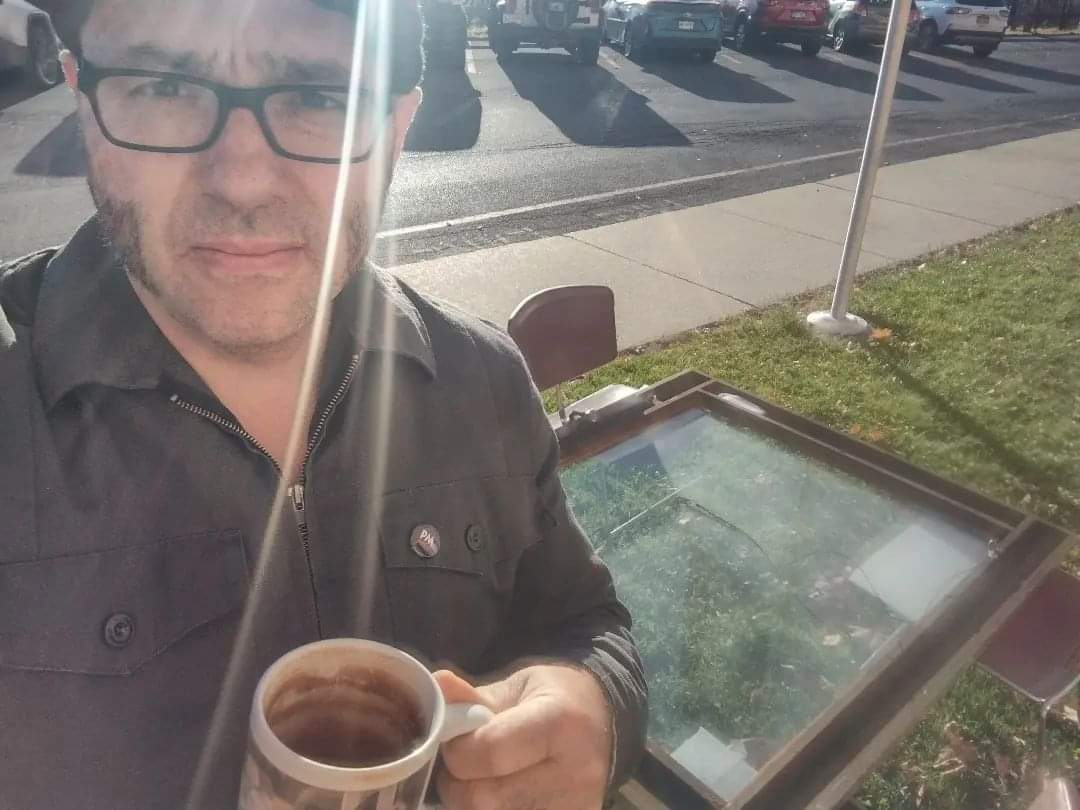
The year of being nervous about the future while still walking toward it, of keeping one’s head down and hands clasped, of trying to connect and sometimes succeeding, of small hopes amid big fears.
Work
Much of my work at the Museum this year was taken up with repatriation. The new regulations issued at the beginning of this year really unsettled the Museum world, and in a good way. They definitely amplified and energized the work we were already doing. For my part, I tried really hard to re-unite wayward ancestral remains and objects with the Indigenous communities who will care for them and welcome them home.
- At the urging of the three Ute Tribes, I applied for a Federal grant to pay for them to visit Hartwick and care for and prepare the human remains and cultural object in our possession to come home. We got the grant, and despite a lot of last-minute changes and other things, we did welcome a Ute delegation to the Museum in November. I am finalizing the last piece of this project, which is to personally take the remains and the object out to Colorado, which I hope to do in late January.
- We made available two sets of human remains to the Mohawk for repatriation, and we are working with them on the logistics of getting them returned and reburied, hopefully in February or March.
- We also opened up consultation and communication with other groups in New York, and will undoubtedly do more in the coming year.
I taught Collections Management again, as well as team-teaching “Collectors and Collecting” with Doug Kendall as part of Hartwick’s First Year FLP102 program. It was a good opportunitiy to dust-off a lot of material culture knowledge and try to use our fascination and obsession with objects to open students minds to their world and the expectations of college education.
I co-curated “With that Shadow Over Them: Constructing Catskill Reservoirs, Remembering Home” with Rachel Gleiberman and Anna Lehr Mueser. I also did the design work and most of the installation. It’s a great exhibit that has been getting a lot of local visitors to the Museum, and I’m very proud of what we put together. I assisted Doug in installing his exhibit on Anna Richards Brewster, and also helped various students and interns in putting together case displays of objects.
I continued to work on Hartwick’s Indigenous DEI committee. We’re still trying to firm up our mission and focus, but we had an excellent Indigenous People’s Day celebration, which foregrounded our Indigenous students and their commmuities, and we’ve made some plans to develop a formal charter and a plan of action to make Hartwick a safer and more accountable place for Indigenous students and communities.
I spearheaded or assisted with almost every program we did, including a visit from Onondaga Lacrosse coach and thought leader Neal Powless, the World of Water (with Hanford Mills Museum), Summer Crafternoons and kids programs, the Horror in the Museum, receptions, elementary school visits, and more. I installed new artwork at Thornwood, supervised the instalation of a new presidential portrait, and worked with a team of really excellent students to begin cataoging a new archaeological collection from Hartwick seminary.
There’s a lot more we did this year that’s still in process, including a new strategic plan, an indigenous artists residency, a number of interesting new accessions, and a grand re-thinking of our Indigenous exhibits. Doug Kendall continues to be a great boss and a thoughtful Museum professional–thanks Doug for everything you do, and for trust you continue to put into me.
Music
This year, I bought or received albums by Richard Shindell, The Replacements (the Rhino edition of the first four records), Phoebe Bridgers, Phosphorescent, Finest Kind, Wednesday, Shellac, Luluc, Cannibal Ox, Caroline Polachek, WU LYF, Flying Lotus, Bob Dylan, The Dodos, and Kendrick Lamar.
- The new (and final) Shellac record is everything you want a Shellac record to be. It’s funny, and snarling, and it sounds fucking amazing. But it’s bittersweet, given the death of Steve Albini. Culturally, he was a partisan for independent music, and its social basis not in business-models or corporate integration, but in scenes; in groups of people who come together over their love of music. He lived those ideals as much as anyone could, as a journalist and thinker, as a musician, and as an engineer and beating heart of Electrical Audio recording company. May a hundred flowers bloom in his footsteps.
- The Replacements collection was in response to my reading “Trouble Boys” (see below). I had never gone in on the ‘Mats when I was younger, and hearing them grow into one of the best rock and roll bands of the 1980s while reading about the consequences of the growth on their bodies and relationships was both exhiliarating and tragic.
Screens
I didn’t think that I watched a lot of new things this year, but when I started listing them, I realized I had logged a bunch of screen time.
I saw The Unbinding, Longlegs, Janine Garofolo: If I May, District 13 (which Alanna swears I’ve seen but I cannot remember any of), Enys Men, Bullet Train, the Golem, Inside Out 2, Hobbs and Shaw, Inside Llewyn Davis, the Garfield Movie, the League, Starship Troopers (thanks for suggesting this horrific and prescient film, hon), A Field in England, Reservation Dogs, Interstellar and Ghosts (UK).
Books
I read 55 books this year.
- A lot of these were books I read with my kiddos, which is a source of bedrock joy that I know will gradually erode as they get older. Dominic and I read Louis Sachar’s Holes, the Wayside Schoool books (which I also read with Hazel!), and Journey to the West. I’d wholeheartedly recommend that you read all three books to kids as thoughtful, funny, and enthusiastic as mine. :)
- I read “Trouble Boys: The True Story of the Replacements” by Bob Mehr. It charts the course of four working-class guys from Minnesota who just happened to be one of the best rock and roll bands in the United States. The tension between their hardscrabble roots (and all of the trauma and substance abuse that are endemic to the American working class) and the fabulous wealth and fame that was thrust on them by record labels is the mill that ground them down and the great tragedy of the book. The music they made was wonderful, and I got to discover a lot of it for the first time as I worked through this.
- Continuing my quest to clear space on my bookshelves, I made my way through two science fiction trilogies: Robert Jackson Bennett’s “Founders Trilogy” and Sylvain Neuvell’s “Take them to the Stars” trilogy. Both were fun and well written and both concerned our ambiguous relationships to technology. Bennett continues to be a master of pacing and plot, while Neuvell’s books were thoughtful about technological progress and what it takes to build a new world.
- The Dagon Collection was a hot ember in the dying fire of my fascination and obsession with HP Lovecraft. If you had cooked up a book in a lab just for me, you’d have a harder time making something better than this fun and creepy ficional auction catalog from the objects taken by the FBI in the raid on Innsmouth.
- I also loved Occult Features of Anarchism, Fire on the Mountain, Larding the Lean Earth: Soil and Science in 19th Century America, Climbers, How Much for Just the Planet?, and The Salt Grows Heavy.
- Books aside, I also found myself reading a lot of poetry this year. I haven’t been much for poetry for a long time, but this year, I found the tight economy of poetry to be comforting. I dipped into collections by Louise Gluck, Seamus Heaney, Wendell Berry, Billy Collins, Raymond Carver, and a few others.
Family
Both kiddos left old schools and started new ones, with Dominic leaving Valleyview for the middle school just as Hazel left Bugbee for Valleyview. They’ve really taken to their new environs, and I’m so proud of both of them, both for growing up and for continuing to be the silly and delightful kids they both are.
I held down the fort while Alanna made another research trip to Mexico. I’m excited for and inspired by all the cool work that she continues to do, both as a researcher and as a professor. Also, I’m not the only one–I was exceedingly proud to see her get the Chancellor’s award for excellence this year. Well done, baby.
We finally sold our rugged and worn early-aughts Toyota Matrix and bought a Prius Prime. It’s been interesting to transition to partially electric driving, as well as the apparently wide-spread and widely-hated trend of new cars having a billion touchscreens.
We went on a number of fun trips.
- We continued our tradition of trekking out to the North Shore of Massachusetts. This all started because we wanted to go on a whale watch as a family, and this year we finally did, and it did not disappoint. While there, we also visited Portsmouth, NH, Marblehead, MA, and our favorite spots in Boston’s North End.
- In April, my Dad turned 80, and a few weeks later, I surprised him with a trip to New York City to visit Museums, including the Met, the MOMA and the Cloisters. We had a wonderful time eating Indian food, drinking great wine, and seeing amazing art. Mostly it was great just to spend a lot of solo time with him, and remind myself what a funny, interesting guy I got lucky enough to be raised by.
- Because the path of totality of the 2024 eclipse was so close, we took a trip to Niagara Falls to see it and have a brief getaway. We went to the Fallsview water park, and ended up seeing the eclipse (such as we could with the clouds) in Oswego, New York, on the eastern shore of Lake Ontario.
- We also made trips to Toronto to see family and friends, St. Lawrence County for a brief overnight in a cabin near the Adirondacks (thanks Tracy and James!), Gilbert Lake for a week-long stay in the cabins, and the Landis Arboretum in the Catskills.
Self
- With the indispensible help of the Minister of Intrigue, I pivoted to using github to store and control my website. It’s much easier to post when I don’t have to be tied to one computer!
- In an effort to help me reduce my cognitive clutter, I bought a Lightphone II. It’s quirky and occasionally buggy, but gets the job done. I definitely spend less time looking at it than my old android!
- I also bought a new guitar. I’ve loved G&L guitars for a long time, and this one didn’t disappoint. My new ASAT tribute is gorgeous and plays beautifully.
- Building on that, I made some music this year in my attempts to find how to play this guitar as it should be played.
- I tried to write a bit of fiction. Inspired by Alanna’s encouragement and Dominic Swain’s “Techniques of the Selling Writer”, I plotted (but haven’t finished writing) a cozy detective novel about an archaeologist who solves a murder while digging test pets for a gas pipeline. I also wrote a couple of short stories, which I may submit if I can hammer them into a readable shape.
- I spent some time knocking on doors for local candidates prior to the election. It seemed to help a little–Josh Riley took back our congressional district, though our local reps remain stubbornly conservative.
- And then there was the bewildering madness of American national politics, which I still don’t really know how to process. Everyone has takes (some of which I find compelling) but it mostly just seems like a variety of overlapping and competing factors and forces led to Trump’s re-election–there is no secret code. It’s interpretable in some academic way, but lately I’ve found my usual enthusiasm for analysis and understanding to be waning. Whatever comes next will be bad, and whatever may limit or hinder the cruelty of what’s to come will be the same things that always do: compassion and care in the face of suffering, solidarity and community in the face of atomization, bravery in the face of danger and uncertainty.
…
As I’ve been writing this yearnotes, I’ve tried to find a way to encapsulate this strange and terrifying year, but like the election that it contained, the picture remains fuzzy. I’m proud of some things, abashed at others. I tried to do some good in the various worlds I inhabit, and I tried to maintain a curiousity about worlds I don’t inhabit. Speaking frankly, I also spent a lot of time ensconced in my own head, and probably could’ve been a more engaged friend, father, partner, and community-member. Much love and humility to everyone in my life who has to deal with my day-dreaming and distraction. I’m working on being more present with you all.
Out the window, in the dim light of the evening, I can see the old, old mountains, and closer at hand, the swiftly melting snow on the sidewalk. A year is a long time, and changes come quickly.
May we meet the new year, and all it will bring, with honesty and bravery and care.
Bring it on, 2025.