Recent Posts (page 31 / 40)

by Quentin Lewis

Quentin's Weeknotes 11/8/20-11/14/20

This week:

by Quentin Lewis

Quentin's Weeknotes 10/25/20-10/31/20

This Week:

by Quentin Lewis

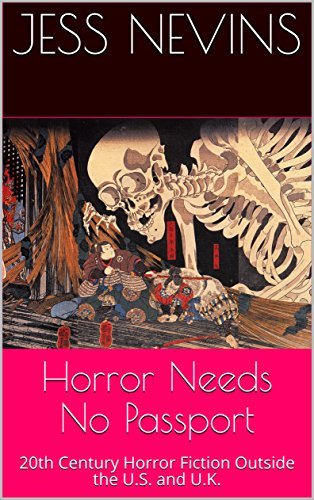
Booknotes: Horror needs no Passport by Jess Nevins

Finished 10/30/20

It is what it says on the can–a wide-ranging bibliographic essay on Horror fiction outside of its more commonly known “haunts” of the UK and the US.

It’s hard to synthesize a book like this, which is essentially a compendium of regional essays–more of a reference guide than a standard piece of non-fiction (and Nevins is both a fantastic fiction scholar and a librarian, so this makes some sense). What follows are some general notes that I made along the way, things that struck my interest, etc…

The book is organized chronologically, with three main periods: 1900-1939, 1940-1970, and 1970-2000, and then regionally within those time periods. In some regions, discussions stretch backward into the 19th century or earlier–there is an interesting discussion about Chinese and Japanese Horror literature going back hundreds or thousands of years. And some of the sections straddle the periods. But generally speaking, Nevins finds a way to bring coherence to the chronology and geography around which he has organized the book, highlighting broader cultural or political trends that impacted horror fiction or fiction more generally, and locating the authors he documents within the regional/chronological literary milieau he sketches. Within these sections, Nevins provides critical biographical sketches of significant authors.

It was fascinating to me to see what an impact the translation of Edgar Allen Poe outside of English or Romance languages had on global horror writing. Poe’s work pops up again and again as influential when it was translated into local or regional languages, whether this was for early 20th century authors in South Africa, Argentina, Iran, Japan, or much later authors influenced by Poe’s eventual translation into Indian languages in 1985(!) Other interesting inspirations came from the spread of Stoker’s Dracula, which inspired early vampire novels in Honduras (Turcios El Vampiro, 1910), Turkey (Gecesi’s Night of Terror, 1958), or India (the anonymously-authored Pischacho ki Mallika, 1997). In each case, local authors took these western sources as an ingredient in their own work, mixed with local folklore, political events, or cultural formations.

Nevins takes a wide view of what constitutes horror, relying on John Clute’s term “fantastika” to encompass a range of fiction with the promotion of fear or dread as a primary or secondary authorial goal. He ends up including everything from dark magical realism to modernist ghost stories to folklore tales rooted in indigenous traditions. This makes for a wide-ranging survey, and eradicates standard distinctions between “High” and “low” literature.

Much of 20th century American horror is rooted in pulp magazines and other popular periodicals. It was fascinating to read about the equivalents to these in other regions, as they too formed a locus of early horror writing. For instance, the “Indian state railways magazine” was an astonishingly widely read periodical (Nevins suggests in the “millions or tens of millions” in the 20s and 30s alone) that routinely featured stories of horror and the supernatural, though often by anoymous authors who brought together British horror forms with Indian folklore.

There is a critical bibliography of scholarship on various authors, regions, and time-periods, but I do wish that Nevins had included an author bibliography for the authors he documents, and with a particular focus on whether the works have been translated into English or not. As a fan of horror, it’d be nice to know beforehand whether I’ll have to learn a second language to enjoy an author whose work he champions.

The book is ultimately a great reference, but ended up being a bit bewildering to read in one sitting. It’s clear that the non-Anglo world of 20th century horror is astonishingly rich, diverse, and complicated, to the point where I felt like I was losing the thread by the end. Having said that, there are several authors whose works I had never heard of and will investigate, thanks to this volume, and for that, I’m glad I read it.

by Quentin Lewis

Quentin's Weeknotes 10/18/20 - 10/24/20

This week (and last week, as I was off work, but still, you know, did some stuff):

  • I wished my brother a happy birthday. He continues to be a source of interesting stuff in my life, from video games to lefty politics. Happy Birthday, Conner!
  • I watched Aterrados (Terrified), an Argentinian horror movie that made some waves when it came out in 2017. It was very good, though its quick pacing was a striking contrast from It Comes at Night, the last horror movie I watched, which was so slow as to be almost soporific.
  • I finished reading Michael McDowell’s “The Elementals”, a fantastic southern Gothic ghost story novel.
  • I finished reading “The Broken Hours” by Jacqueline Baker. The basic plot is that it’s about a man in the 1930s who goes to work for an ailing HP Lovecraft in a decaying house in Providence, RI. But really it’s about class, mental illness, and the ways we try and fail to break out of the roles into which we are thrust.
  • I hosted the Yager Museum’s conversation with Luke Swinson, whose artwork is currently featured in the exhibit “dadibaajimo: Two Mississauga Artists Share Stories.” We had a great chat, which you can still watch on the Museum’s facebook page.
  • Along with a Museum studies student, I launched a new video series for the Museum called “The Yager Through your Eyes” featuring Hartwick college faculty, staff, and students talking about their favorite objects. The first installment, featuring Hartwick student Gabriel Valenzuela (‘23) can be viewed on Youtube and facebook.
  • In MUST250 “Collectors and Collecting” we learned about the history of Oneonta from historian Mark Simonson, the students took their mid-term exam, and we worked more on the wikipedia project.
  • I was shocked and saddened to learn of the sudden death of Professor Mary Beaudry. An eminent and prolific scholar in Historical Archaeology (what a CV!), Beaudry was a major figure in the study of the material culture of the modern world, and conducted rich and important research projects in New England, Scotland, and the Caribbean. She wrote about gender, class, race, and the role material objects play in those social forces in really sophisticated and interesting ways. She was a firm advocate for women in a field mostly dominated by men or seen as a masculine pursuit, and she both wrote and spoke eloquently about sexism in the profession. She was also my undergraduate advisor, an important mentor who let me know that my eclectic and often scattered interests could find a home in archaeology.  She inspired, pushed, and helped me to go on to graduate school and that decision has shaped every aspect of my life since, and she remained a supportive and generous colleague years later. My sense, in seeing the responses from others, is that her considerate and deep support for her students was widely shared. Rest in Peace and in Power.
by Quentin Lewis

Quentin's Weeknotes 10/4/20-10/10/20

This Week:

by Quentin Lewis

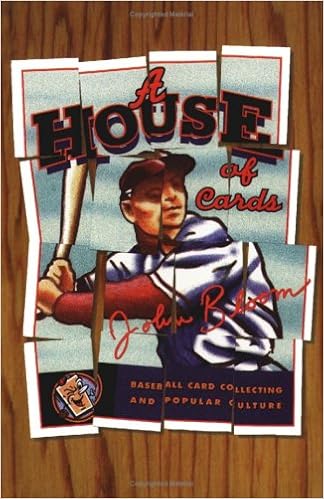
Booknotes: A House of Cards by John Bloom

A House of Cards: Baseball Card Collecting and Popular Culture
Finished 10/4/20

A rich and interesting study that links collecting, popular culture, structural analysis, sports studies, and historical memory.

This book is the result of Bloom’s PhD research, in which he attempts to locate Baseball card collecting as a site of meaningful, if contradictory social processes. As he notes in the opening chapter, he is interested how " the popularization of baseball nostalgia throughout the past one hundred years illustrates not only conflicting ways of appreciating sports but also the conflicting positions men often feel themselves assuming within modern structures." In other words, he explores baseball card collecting as a mechanism through which men grapple with what it meant to be men once, and what it might mean to be a man today.This is a unique approach to the study of collecting, which often side-steps the structural nodes of meaning that hover over collections in favor of a focus on economic value, or on the idiosyncratic (and individualistic) meanings that collectors place upon their own collections. Indeed, Bloom writes cogently about the ways in which value itself was a site of tension within baseball card collectors as a group, and how the increasing commoditization of a youthful and emotaionally affective hobby brought about contradictions in the ways in which collectors understood themselves and their collections.

Chapter 1 surveys the history of baseball cards from an industry and production standpoint, as well as setting some of the terrain for discussing the organized baseball card collecting world. As he notes, baseball cards (spear-headed for most of the 20th century by the Topps candy company) are a multi-million dollar industry even before the issue of secondary collecting, trading, and valuation markets. This has some important consequences for the subsequent analysis. For one thing, there is no pure period preceding collecting in which baseball cards are not commodities. Whether they were ancilliary to candy marketing, caught up in anti-competitive monopolizing by Topps, or refocused on adults due to demographic and marketing research changes, baseball cards have never been purely emotional or personal objects.

Chapter 1 also sketches some of the primary means through which baseball card collectors form an organized hobby. He discusses collecting journals and newsletters, such as Sports Collectors Digest. He notes that the proliferation of collecting as an economic activity, with major media news stories about the high prices fetched by rare cards, were a source of consternation for many collectors, who saw themselves as engaged in a pre-economic hobby that should not have been commodified. Likewise, the growth of newsletters and journals into mass-media organs required a level of control and professionalism that often rankled collectors as impersonal and alienated.

Chapter 2 foregrounds Bloom’s ethnographic research at baseball card shows in the upper midwest in the late 1980s. Such shows, in which dealers, hobbyists, sports stars and others mingled, sold and traded memorabilia, and socialized were useful points for examining the meaning of baseball cards because though fans attended such shows “out of a sense of belonging, …this also meant creating distinctions of who belonged and who did not, particularly as adult collecting grew increasingly pluralistic, its boundaries ever harder to define.” Such tensions were particularly visible around the dismissive treatment of children at shows, despite most adult male dealers nostalgia for their own childhood collecting, and the treatment of women, who were largely in supporting roles to male dealers or collectors. Bloom also discusses how the growth of the Midwest Collector’s club embodied issues of inclusion and exclusion, as the growth of the hobby built around monetary exchange exascerbated tensions around race and class and expanded competitive sentiments between supposedly amiable collectors.

Chapter 3 builds on this ethnographic account with a focus on collecting sets of cards, either creating complete sets of older cards or purchasing brand new sets whole in the hopes of finding valuable cards therein. Set collecting provides a vantage point for exploring how collectors who began the hobby as children understood its growth and transformation as they continued into adulthood. Particularly for completist set collectors who were attempting to construct sets they had as children, meticulous set collecting provided a way of nostalgically continuing a childhood hobby, but with a rationalized focus that prevented accusations of it being childlike. Bloom argues that the distinctions between the affective and emotional bonds of childhood baseball card collecting stand in contrast to the more rigid, competitive world of adult collecting, and that the masculine tension inherent in “becoming a man” required a reconfiguration of the nature of this childish hobby that in some ways, drained it of the qualities that made it emotionally rich for them as children.

Chapter 4 cotinues this focus on the tensions between collecting as a youthful hobby to an adult masculine one by examining sports collecting newsletters in the 1970s and 1980s. Perhaps most provocatively, Bloom argues that the growth of professionalized sports card collecting during this time functioned to culturally shield men from the challenges to their authority wrought by the protest movements of the 1960s. The nostalgia inherent in card collecting for childhood was also a nostalgia for a pre-political past in which white patriarchal authority was unquestioned. But he also is quick to point out that such nostalgia belies the ways in which race, class, and gender were themselves in flux in the 1950s. As an example, the growth of baseball cards as the medium through which boys experienced baseball was a function of white flight, which took families away from urban ballparks and into distant suburbs; baseball cards became a commodity that stood in for park attendance, and cards themselves frequently deployed television as a design language that suburban TV watching viewers would have appreciated. And baseball’s centrality as a “national pastime” that unified rather than divided, was a conceit that was actively promoted by team owners and players, but belied by a racially segregated game.

In the conclusion, Bloom restates his thesis that card collecting allowed middle-class white men to make meaning of their relationships to their own masculinity and class position, even as both were in states of flux. Such practices allowed for creativity and self-expression in the often soul-destroying work environments that such men inhabited, functioning as a kind of adult play, even as it reified ideas of patriarchal authority, men’s social and cultural distance from women, and an ethic of individualist competition that inhibited or complicated male-to-male friendship and solidarity. Bloom draws parallels to this kind of conservative nostalgia and the growing (at least in the 1990s) affection for Conservative (capital C) talk-radio and the growth of the middle-class right. But Bloom is also sympathetic to the ways in which fan culture, even one rut with nostalgia, can be a source of genuine pleasure and affective bonding between men, noting “sports remain a powerful component of popular pleasures that many men have a hard time abandoning.”

The book is rich in insights about the relationship between sports, fandom, and masculinity, and locates such relationships both within the political-economic and cultural milieu of the late 20th century, as well as within specific contexts of midwestern sports card collectors. It’s a really fascinating study both for its insights into material culture and collecting, as well as into patriarchal and class structures as they manifest in popular culture.

by Quentin Lewis

Quentin's Weeknotes 9/27/20-10/3/20

This Week:

  • I watched “It Comes at Night”, another in a line of of moody, character-driven horror movies from A24. I like movies where it’s unclear what the horror actually is, and the best thing I can say about “It comes at night” is that it’s a zombie movie without any zombies. Recommended!
  • I taught wikipedia to our students this week, using the amazing wiki-edu infrastructure.
  • I started planning for the Museum’s Halloween storytelling event “The Horror in the Museum” as well as for an artist conversation with Luke Swinson, whose work is currently on display at the Museum.
  • I read this old essay by M. John Harrison entitled “Very Afraid” in which he shoots across the bow of most speculative fiction’s insistence on something called “world building,” which he describes as “an attempt to exhaustively survey a place that isn’t there,” and later as “an attempt… to rationalise the fiction by exhaustive grounding, or by making it ’logical in its own terms’, so that it becomes less an act of imagination than the literalisation of one.” It’s a long-ish essay, and there’s a lot in it for writers, but Harrison provides a rigorous intellectual scaffold for my essentially unformed aesthetic opinion that most exposition in science fiction, fantasy, and especially horror is pretty boring and patronising. But Harrison goes further, and links the world-building impulse to our currently decaying post-modern/neoliberal order of intellectual (and political-economic) libertarianism and the unbridled superiority of humans over nature that it implies.

The originally vertiginous and politically exciting notion of relativism that underlies the idea of “worlds” is now only one of the day-to-day huckstering mechanisms of neoliberalism. My argument isn’t really with writers, readers or gamers, (or even with franchisers in either the new or old media); it is a political argument, made even more urgent as a heavily-mediatised world moves from the prosthetic to the virtual, allowing the massively managed and flattered contemporary self to ignore the steady destruction of the actual world on which it depends.

It shook me to read this piece, especially given the news that the world-building which organizes so much of American politics right is at this moment collapsing like a dying star.

by Quentin Lewis

Quentin's Weeknotes 9/20/20-9/26/20

This Week:

by Quentin Lewis

Book Notes: The Ministry of Nostalgia: Consuming Austerity by Owen Hatherley

The Ministry of Nostalgia: Consuming Austerity

by Owen Hatherley

Finished 9/20/20


A clever and pointed look at the ways in which objects, spaces, and memory of 20th century social democracy in the UK have been transformed into contemporary commodities that obscure their political origins and content.

Owen Hatherley is a wonderfully rebellious UK architectural and cultural critic. He wrote two excellent books on modern architecture (A Guide to the New Ruins of Great Britain, and A New Kind of Bleak), as well as Militant Modernism, all of which seek to excavate the social-democratic project of post-War British architecture and politics from contemporary scorn, as well as to evaluate the architectural footprint of UK neoliberalism and New Labour.

This book builds off this previous exploration to focus attention on the recent explosion of what Hatherley calls “Austerity Nostalgia”, manifesting in various consumer goods, decorative objects, and souveneirs. He begins with an examination of the now-ubiquitous “KEEP CALM AND CARRY ON"poster, which despite being associated with the Blitz and WWII, was never actually widely distributed until the 2000s. The resurgence of this image coincided with the period following the 2008 financial crash and the beginnings of continuous conservative governance in the UK, and Hatherley argues that there was a significant cultural investment in the aesthetics of the WWII and post-war rationing eras of “make do and mend.” Such nostalgia, manifested in art, music, television, and “heritage” belies a depoliticized aestheticization of socialist or social-democratic efforts during the 20th century that created comfortable and beautiful public housing, public art and cinema, and most dramatically, the National Health Services.

Hatherley moves from Keep Calm and Carry on through various cultural dimensions of the current and the historical moments of austerity. He examines the ways in which conceptualizations of the White working class in England as a source of political energy belie the connections between class and empire in the post-war period. As a source of analysis, he examines some documentary films that play on nationalist nostalgia for the social-democratic impulses of this time. He later offers a rich and pointed tour of some of the archtiectural and historical literature which has recently been written on post-war modernist architecture, and finds it lacking in its recognition of the complex politics at play in things like the expansion of the London subway system, or the Empire marketing board, which sought to inspire the English to buy commodities from their colonies.

The book is full of little details that complicate the “make do and mend” ethos. In chapter 4, Hatherley reminds us that the backyard or neighborhood bomb-shelter, that architectural icon of British survival spirit, was a function of elite concern over rebellious politics.

“while the Labour left and radical architects were advocating communal shelters, central government had a firm preference for the privatisation of bomb protection….If big, safe, deep shelters were established, people would simply lie in them and do no work. Worse, such concentrations of proletarians could be breeding grounds for mass hysteria, even subversion.”

He touches on George Orwell’s conversation from radical socialist to conservative skeptic, the Festival of Britain and its architectural ghosts, and the public housing efforts of Aneurin Bevan. He also provides a tour of the archtiecture and exhibits of the Imperial War Museum which is snarky and entertaining.

But his ultimate point, indeed perhaps his professional thesis, is reserved for the last chapter:

In Britain today we are living through exactly the kind of housing crisis for which council housing was invented in the first place, at exactly the same time as we’re alternately fetishising and privatising its remnants…we face a massive problem for which, once, the solution was the building of well-designed, well-considered, well-planned modernist buildings, often erected on the ashes of the shoddily-designed, unplanned, badly made, profit-driven housing of the past. Instead, what is actually happening is that we’re transforming the surviving fragments of that solution into one of the main contributors to the problem, as social housing becomes the new front line of gentrification, and the architect-designed modernist flat the new loft conversion.

In short, at the same time that the post-war, social democratic built environment of Britain is being remembered and revered in art, music, culture, and archticture, it is likewise being reshaped and repurposed by Conservatives, New Labour, speculation, and gentrification around a rampant neoliberal privatization that exascerbates the problems it was erected to solve.

All in all, fascinating, funny, and clarifying book and study of place, space, power, and material things.

by Quentin Lewis

Quentin's Weeknotes 9/12/20-9/19/20

This Week: